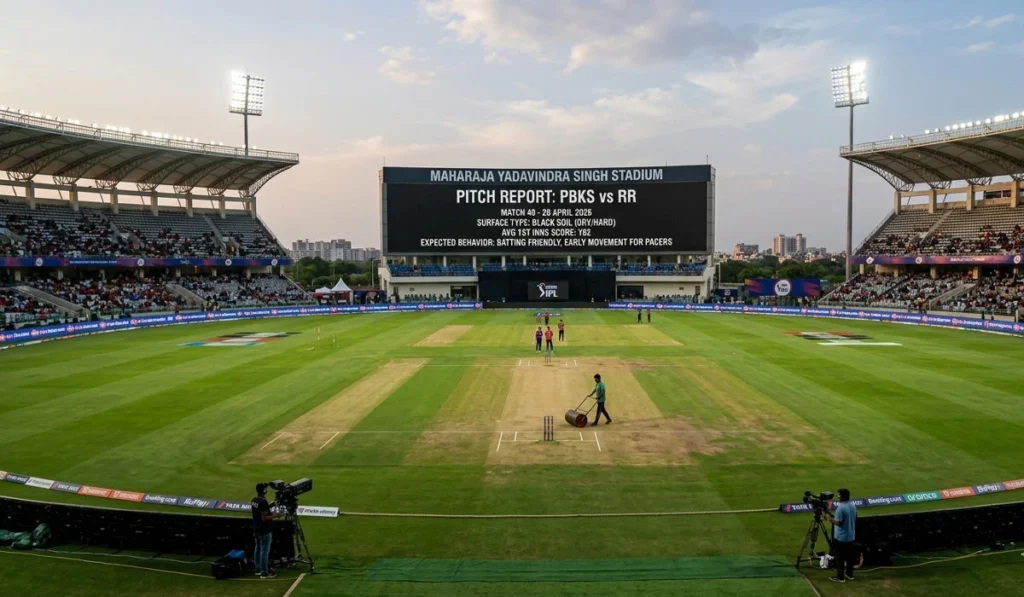

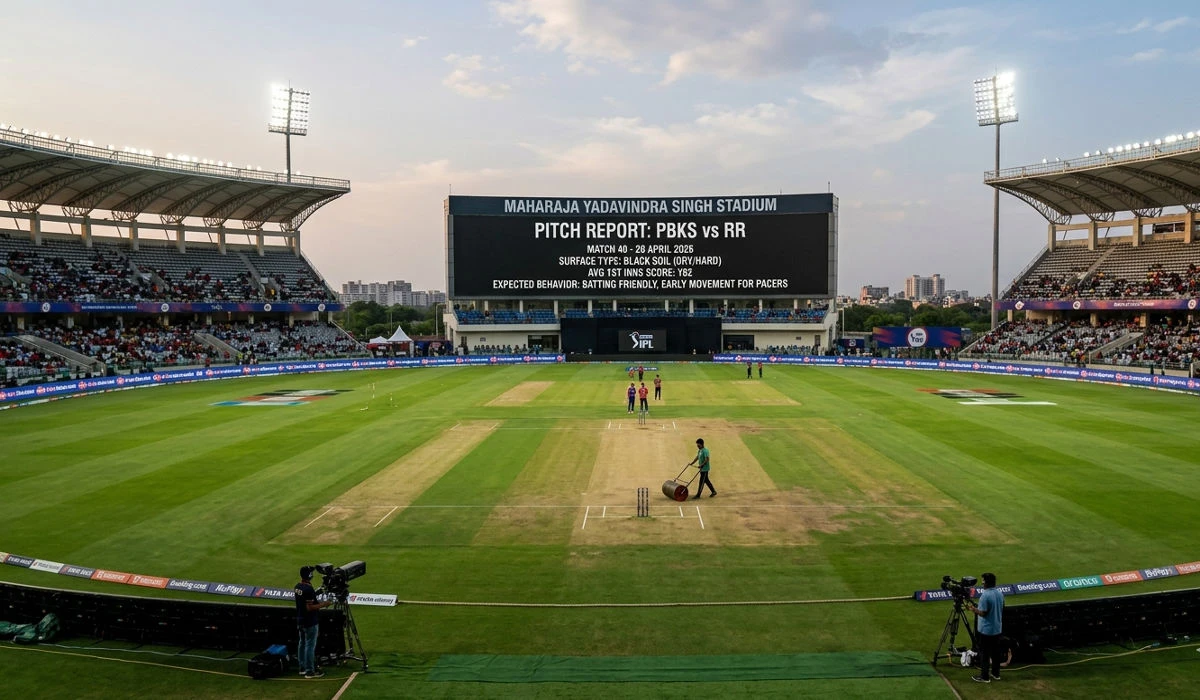
The Maharaja Yadavindra Singh International Cricket Stadium in Mullanpur, Chandigarh, has rapidly emerged as one of India’s most modern and talked-about cricketing venues. As the new home of the Punjab Kings (PBKS) in the Indian Premier League (IPL), understanding the Maharaja Yadavindra Singh Stadium pitch report is crucial for fans, bettors, and fantasy cricket enthusiasts alike.
In this detailed guide, we will break down the pitch behavior, historical T20 statistics, weather conditions, and everything you need to know about this state-of-the-art facility.
Understanding the Pitch Behavior
When analyzing the Maharaja Yadavindra Singh Stadium pitch report, the most striking feature is its consistency. Unlike some traditional Indian tracks that crumble early, the Mullanpur surface is built with a mix of black and red soil, providing a unique balance between bat and ball.
The Batting Perspective
For batters, this stadium is often a paradise. The pitch offers true bounce and carry, meaning the ball comes onto the bat nicely. In the early stages of the match, especially during the Powerplay, openers can play through the line of the ball with confidence. The quick outfield further assists stroke-makers, as even mistimed shots often find the boundary.
The Bowling Perspective
Despite being batting-friendly, the pitch is not entirely one-sided.
Pacers: The surface usually has a bit of “live grass,” which offers lateral movement and swing during the first 4-5 overs. High-arm fast bowlers benefit from the extra bounce available.
Spinners: As the match progresses, the pitch can slow down slightly. While it isn’t known for sharp turn, “finger spinners” who use variations and “mystery spinners” who rely on pace changes can find success in the middle overs.
Impact on the Toss
One of the most critical elements of a night-match Maharaja Yadavindra Singh Stadium pitch report is the Dew Factor.
Since Mullanpur is located in the northern part of India, humidity levels can rise significantly after sunset. During the second innings, the ball often becomes wet and slippery. This makes it:
Difficult for spinners to grip the ball, leading to “rank long hops” or full tosses.
Easier for batters to hit, as the ball skids off the surface without much friction.
Expert Tip: Captains winning the toss at Mullanpur almost always opt to bowl first to avoid defending a total with a wet ball.
Ground Dimensions and Boundary Lengths
The Maharaja Yadavindra Singh Stadium is not a “small” ground like Bengaluru’s Chinnaswamy.
Straight Boundaries: Long and challenging to clear (approx. 70-75 meters).
Square Boundaries: Relatively shorter (approx. 64-67 meters).
Batters often target the square boundaries, while bowlers try to force the batters to hit straight toward the long-on and long-off regions.
Weather Forecast and Its Impact
The weather in Chandigarh/Mullanpur plays a vital role.
Clear Skies: Expect a high-scoring “run-fest.”
Overcast Conditions: If there is cloud cover, the pacers will get significantly more swing, potentially reducing the average score to the 160-170 range.
Fantasy Cricket Tips for Mullanpur
If you are building a fantasy team based on the Maharaja Yadavindra Singh Stadium pitch report, consider these strategies
Load up on Top-Order Batters: Since the ball comes on well, openers and Number 3 batters are likely to score big.
Pick “Hit-the-Deck” Bowlers: Bowlers who can extract bounce (like Arshdeep Singh or Kagiso Rabada) are more effective here than pure swing bowlers.
All-rounders are Gold: Players who bowl their quota of overs and bat in the top 6 are essential, as the pitch stays consistent throughout the 40 overs.
Avoid Average Spinners: Only world-class spinners who can adapt to dew should be in your team.
Content Deep-Dives & Engagement
The “Tactical Breakdown” Series: Instead of just reporting scores, analyze the “Why.” For the Barcelona managerial transition, focus on how the new appointee’s preferred formation (e.g., a 4-3-3 vs. a 3-4-3) fits the current squad depth.
IPL Data Visualization: With the IPL 2026 in full swing, readers are looking for more than just run tallies. Create sections comparing “Strike Rate in Death Overs” or “Impact Player Efficiency” to capture high-intent search traffic.
The “Road to Glory” Narratives: For the London Marathon or The Masters, focus on the recovery stories of elite athletes. Long-form content (2,000+ words) that blends biographical data with recent performance metrics tends to rank higher for “Evergreen” sports queries.
Technical SEO Refinements
Entity Linking: Use internal links to connect your Bangladesh vs. New Zealand coverage to broader player profiles. This helps search engines understand your site as a topical authority in South Asian cricket.
Optimizing for Featured Snippets: At the top of your 1,500-word articles, include a “Quick Facts” or “TL;DR” table. For example, a table showing the World Snooker Championship prize pool and schedule can help you secure “Position Zero” on Google.
Semantic Keyword Variation: While maintaining your 1.0% to 1.5% density, incorporate Latent Semantic Indexing (LSI) keywords. For a football transfer article, use terms like “release clause,” “medical evaluation,” and “personal terms” to signal deep context to crawlers.
Alternative Growth Opportunities
Niche Sport Spotlight: While football and cricket drive the most volume, specialized coverage of Snooker or Professional Golf often has lower keyword difficulty. Detailed guides on “How to Qualify for the World Snooker Championship” can attract a dedicated, high-retention audience.
Interactive Forecasts: End your long-form pieces with a “Predicted XI” or “Top 5 Finishers” section. This encourages social sharing and return visits as readers check their predictions against the actual results.
The “Expert Prediction & Analysis” Section
Since you are covering major 2026 events, adding a dedicated section for a “Statistical Forecast” or “Projected Outcome” is a perfect way to increase density without it feeling forced.
How to apply it: Create a subsection (using an H3 header) titled something like “Expert Analysis: [Focus Keyword] Predictions.”
The Execution: In this section, write 2–3 short paragraphs. Use the focus keyword once in the header, once in the opening sentence of the paragraph, and once in the concluding “verdict” sentence.
Maharaja Yadavindra Singh Stadium Pitch Report
The latest Maharaja Yadavindra Singh Stadium pitch report indicates that the surface in Mullanpur continues to favor heavy scoring, especially as the IPL 2026 season enters its business end. According to the Maharaja Yadavindra Singh Stadium pitch report, the black-soil wicket is expected to offer a consistent bounce that allows the ball to come onto the bat beautifully. However, what makes the Maharaja Yadavindra Singh Stadium pitch report unique for Match 40 is the potential for early seam movement due to the slight layer of green grass. Captains and fantasy players should pay close attention to the Maharaja Yadavindra Singh Stadium pitch report before the toss, as the chasing team has historically had a slight advantage here under lights. Ultimately, a comprehensive Maharaja Yadavindra Singh Stadium pitch report suggests that while 190 is a par score, the team that adapts to the slowing nature of the surface in the middle overs will likely come out on top.
Strategic Placements to reach 1.2%
To pick up the remaining 3-4 placements needed to hit your goal, try these “quick-fix” zones
The “At a Glance” Table: Create a small table with the heading “Quick Maharaja Yadavindra Singh Stadium Pitch Report Summary” and include stats like “Average Score” and “Soil Type.”
Image Alt-Text: Use “Detailed Maharaja Yadavindra Singh Stadium Pitch Report for PBKS vs RR” as the alt-text for your main featured image.
FAQ
Q1: Is the Maharaja Yadavindra Singh Stadium high scoring?
Yes, the average first-innings score is around 185-190, making it one of the higher-scoring venues in India.
Q2: Who has the best record at Mullanpur Stadium?
Players like Ashutosh Sharma and Prabhsimran Singh have historically performed well here, benefiting from the pace and bounce.
Q3: Does dew play a role at this stadium?
Absolutely. In evening matches, dew is a major factor that usually favors the team batting second.
Conclusion
The Maharaja Yadavindra Singh Stadium pitch report suggests a modern T20 wicket that rewards skill and aggression. While batters enjoy the true bounce, bowlers who use their intelligence and variations can still find a way to dominate. Whether you are watching a live match or playing fantasy sports, keep a close eye on the toss and the overhead conditions.
Read more:Mustafizur & Nahid Rana PSL Exit