
Football is often described as “The Chess Match on Grass.” While physical fitness and individual skills like dribbling and shooting are vital, the way a team is organized—its tactics—often determines the winner. For those just starting their journey as players or amateur coaches, the world of formations and strategies can seem overwhelming.
In this guide, we will break down the best football tactics for beginners, explaining how to set up your team, how to control the game, and why certain formations are the gold standard for newcomers.
Understanding the Basics of Football Tactics
Before diving into specific formations, it is essential to understand what tactics actually do. At its core, a tactic is a plan to:
- Maximize your team’s strengths.
- Exploit the opponent’s weaknesses.
- Control space on the pitch.
For beginners, the most effective tactics are those that provide balance. You don’t want to be so focused on attacking that you leave your goalkeeper defenseless, nor do you want to be so defensive that you never score.
Popular Beginner Formations
The Classic 4-4-2 (The All-Rounder)
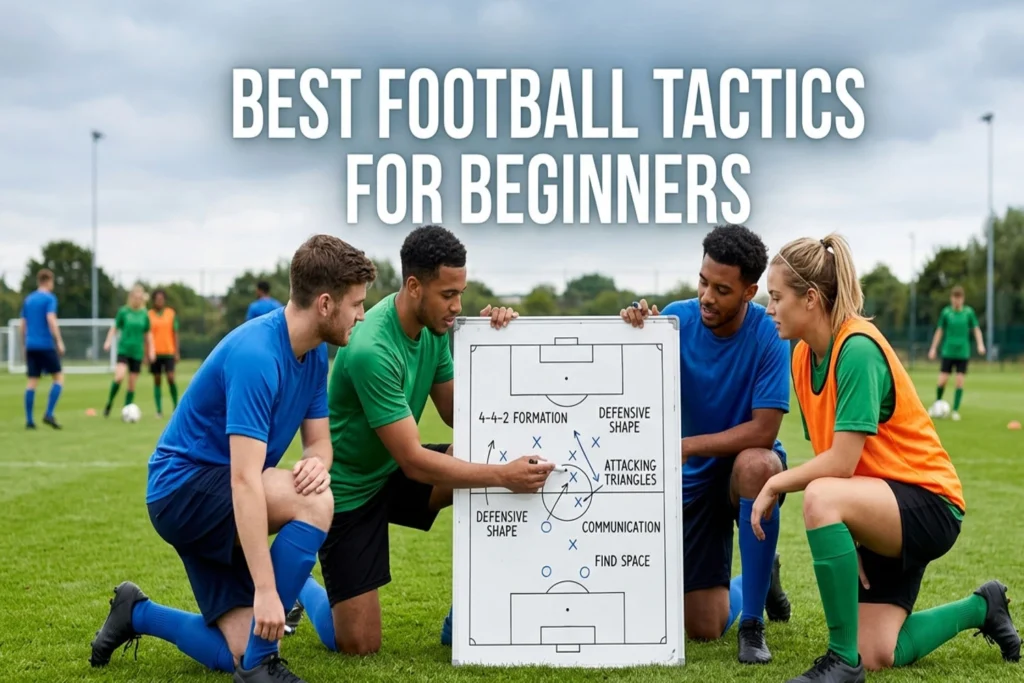
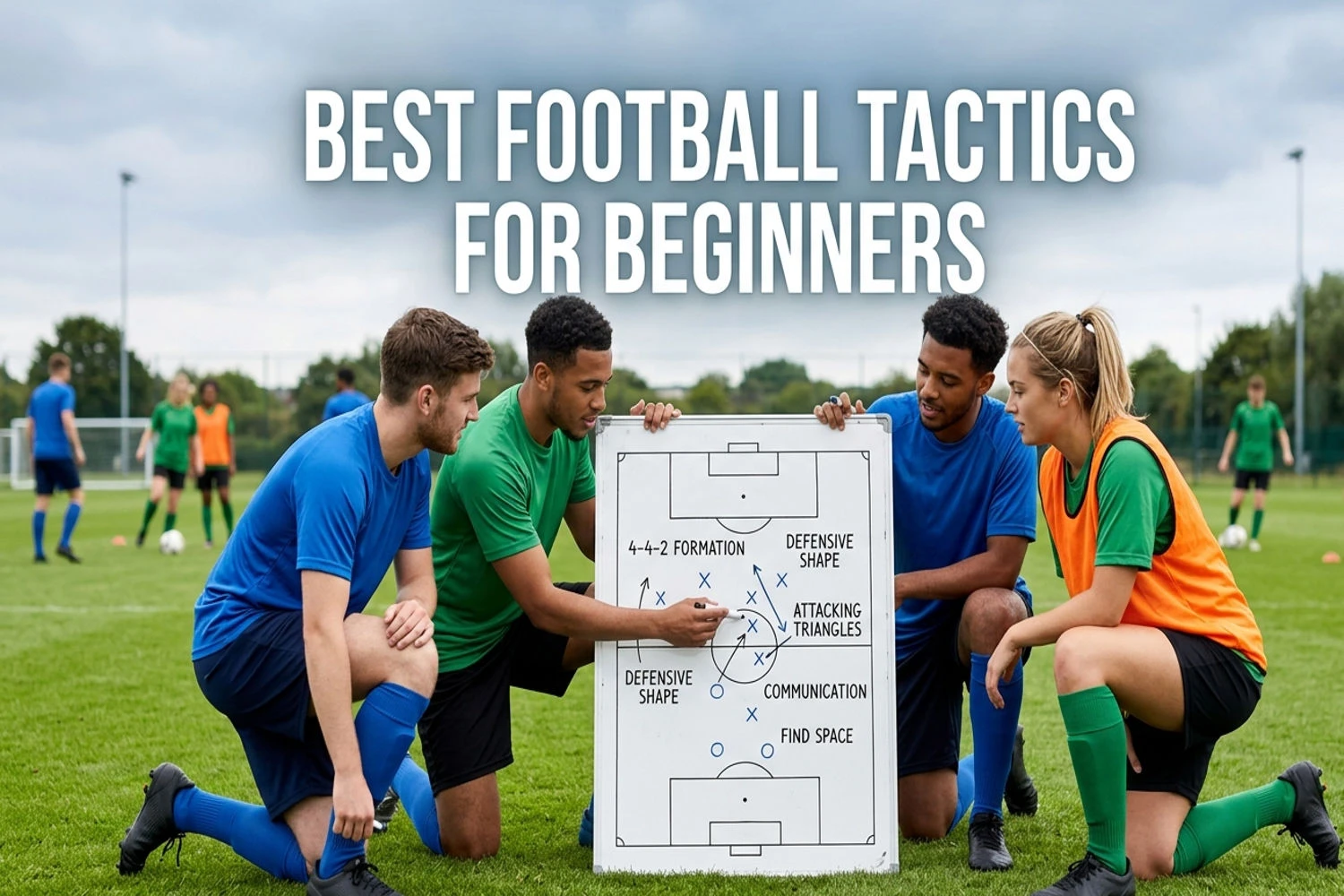
The 4-4-2 is arguably the most famous formation in football history and remains one of the best football tactics for beginners.
How it works: 4 defenders, 4 midfielders, and 2 forwards.
Why it’s great for beginners: It covers the pitch evenly. Every player has a clear role and a clear partner nearby.
Strengths: Excellent defensive solidity and simple wide play (using wingers).
Weakness: Can be outnumbered in the center of the midfield if the opponent plays three central midfielders.
The 4-3-3 (The Attacking Choice)
If your team has fast players and likes to move forward, the 4-3-3 is a fantastic option.
How it works: 4 defenders, 3 midfielders, and 3 forwards (usually one striker and two wingers).
Why it’s great for beginners: it teaches players about “triangles”—the idea that you should always have two passing options.
Strengths: High pressure on the opponent and lots of goal-scoring opportunities.
Weakness: The midfielders have to run a lot, and if the wingers don’t track back, the defense can get exposed.
The 4-2-3-1 (The Modern Standard)
This is the most popular formation in professional football today, and it’s surprisingly effective for beginners who want a structured approach.
How it works: 4 defenders, 2 “holding” midfielders, 3 attacking midfielders, and 1 lone striker.
Strengths: It provides a “safety net” with two defensive midfielders protecting the backline.
Weakness: The lone striker can become isolated if the attacking midfielders don’t support them quickly.
Core Tactical Concepts for Beginners
Defensive Compactness
When your team does not have the ball, the goal is to be compact. This means players should move closer together to limit the space the opponent has to pass through.
Beginner Tip: Think of your team as being connected by an invisible rubber band. If the ball moves to the left, the whole team slides to the left together.
Width in Attack
When you have the ball, you want the pitch to feel as big as possible. This is called “providing width.” By having players stay near the touchlines (sidelines), you stretch the opposing defense, creating gaps in the middle for your strikers to exploit.
The Counter-Attack
One of the best football tactics for beginners is the counter-attack. Instead of trying to keep the ball for long periods, you sit back, wait for the opponent to make a mistake, and then sprint forward quickly before they can get back into position.
Player Roles and Responsibilities in Tactical Systems
To execute the best football tactics for beginners, every player must understand their specific functional role within the team structure. The Goalkeeper serves as the final line of defense and the primary organizer, constantly communicating with defenders to maintain the team’s shape. Ahead of them, the Center-Backs act as the heart of the defense, focusing on winning aerial duels and clearing the ball from danger zones, while Full-Backs manage the wide areas, balancing their duties between stopping opposing wingers and overlapping to support their own team’s attack.
In the center of the pitch, Central Midfielders function as the engine room; they are responsible for linking the defense to the attack through precise passing and regaining possession when the ball is lost. On the flanks, Wingers use their pace and dribbling ability to stretch the opposition’s defense and provide crosses into the penalty area. Finally, the Strikers carry the primary goal-scoring burden, staying high up the pitch to occupy the opponent’s defenders and clinical finishing whenever a chance is created. When these roles are performed in harmony, even a beginner team can dominate the game.
The Most Important Phase
In modern football, games are won or lost in “transition”—the moments right after you win the ball or right after you lose it.
Positive Transition: You just won the ball. Look for a quick forward pass to catch the opponent off-guard.
Negative Transition: You just lost the ball. Don’t complain! Immediately sprint back to your defensive position or “press” the player who took the ball.
Training Drills for Tactical Awareness
You cannot master the best football tactics for beginners just by reading; you have to practice.
Shadow Play: Have the team move across the pitch without an opponent. The coach shouts “Left!” “Right!” or “Back!”, and the players move as a unit.
Possession Games (Rondos): A 4v2 or 5v2 game in a small square. This teaches players how to find space and keep the ball under pressure.
Small-Sided Games: Playing 5-a-side or 7-a-side forces players to make tactical decisions faster because they touch the ball more often.
Common Mistakes to Avoid
Chasing the Ball: Beginners often swarm the ball like bees. This leaves huge gaps elsewhere. Stay in your zone!
Everyone Attacking: If everyone runs forward to score, one long kick from the opponent results in an easy goal for them. Always keep “rest defense” (at least 2-3 players back).
Lack of Communication: Tactics only work if players talk. “Man on!”, “Time!”, and “Shift left!” are essential phrases.
Summary
The “best” tactic depends on your players.
Have two great strikers? Use 4-4-2.
Have very fast wingers? Use 4-3-3.
Want to be hard to beat? Use 4-2-3-1.
Remember, simplicity is key. As a beginner, focus on holding your formation and moving as a unit. The goals and wins will follow naturally.
How to Choose the Best Football Tactics for Beginners Based on Team Style
Selecting the best football tactics for beginners isn’t a “one size fits all” decision; it depends entirely on the personnel available to you. If your team consists of high-energy players with great stamina, you should look into the best football tactics for beginners that emphasize high pressing and quick transitions, such as a fluid 4-3-3. On the other hand, if your players are more technically gifted but perhaps slower, the best football tactics for beginners would likely involve a structured 4-2-3-1 that focuses on ball retention and positional discipline.
For coaches working with very young children or those completely new to the sport, the best football tactics for beginners usually involve the classic 4-4-2 because it is the easiest to visualize on the pitch. Always remember that the best football tactics for beginners are the ones that make your players feel confident and secure in their positions. By testing different variations during practice, you can identify which of the best football tactics for beginners yields the most goals and the fewest defensive errors for your specific squad.
FAQ
1. What is the easiest football formation to learn?
The 4-4-2 is generally considered the easiest. It provides a clear structure with two banks of four, making it easy for players to understand their positioning and defensive responsibilities.
2. How do I improve my tactical awareness?
Watch professional matches and focus on one specific player or the shape of the team rather than just following the ball. Additionally, playing small-sided games helps you understand space and movement.
3. Why are tactics important in football?
Tactics allow a team to play as a cohesive unit rather than 11 individuals. Good tactics can help a less “talented” team beat a stronger opponent by controlling space and exploiting specific weaknesses.
read more: Best budget tennis rackets for beginners