
The year 2026 marks one of the most significant turning points in the history of association football. While the world’s eyes are fixed on the expanded FIFA World Cup, a deeper transformation is occurring within the fabric of the game’s laws. The introduction and integration of the Blue Card have moved from experimental “sin-bin” trials to a defining feature of modern officiating. Understanding the impact of Blue Card in football 2026 is essential for fans, players, and coaches alike, as it represents the first major disciplinary addition since the 1970 World Cup.
What is the Blue Card in Football?
Before diving into its global impact, we must define what this new disciplinary tool entails. Unlike the traditional Yellow Card (caution) and Red Card (dismissal), the Blue Card serves as a middle ground.
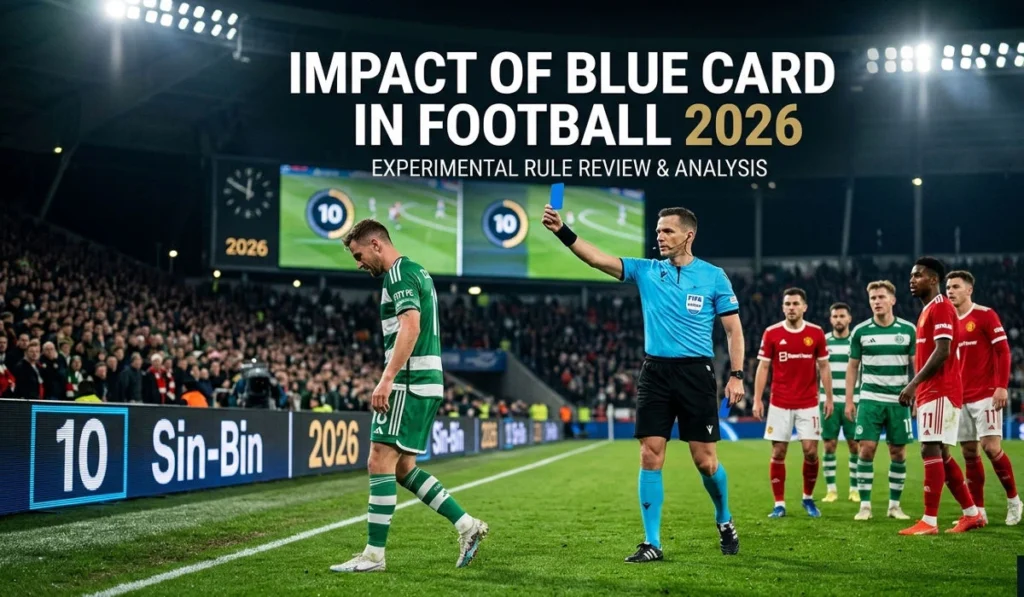
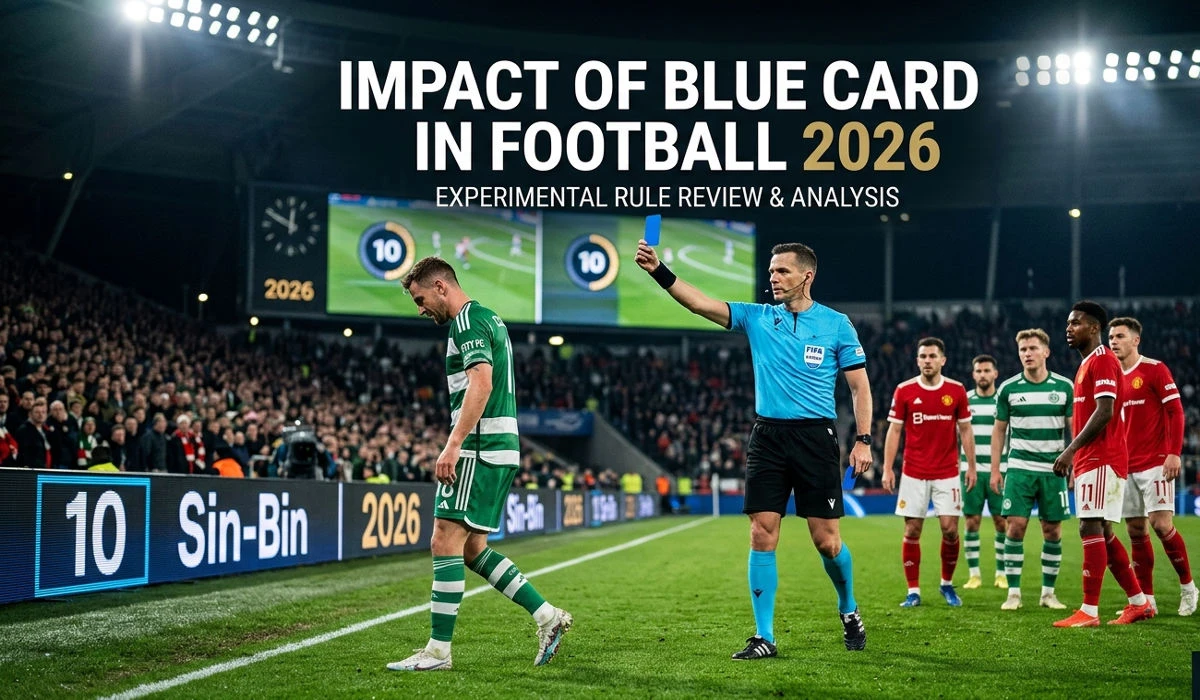
When a referee brandishes a Blue Card, the offending player is sent to a “Sin-Bin”—a designated technical area—for a duration of 10 minutes. Following this period, the player may return to the field, provided there is a break in play and the referee signals their reentry.
The Criteria for a Blue Card
By 2026, the International Football Association Board (IFAB) has refined the specific triggers for a Blue Card
Dissent: Excessive verbal or physical protest against match officials.
Cynical Tactical Fouls: Blatant fouls intended to stop a “promising attack” that do not meet the “denial of an obvious goal-scoring opportunity” (DOGSO) threshold for a red card.
How Managers are Adapting
The most immediate impact of Blue Card in football 2026 is seen on the manager’s tactical board. The “10-minute disadvantage” has forced coaches to develop specific “Sin-Bin Drills.”
Defensive Consolidation
When a team loses a player for 10 minutes, the tactical shift is often a move to a “Low Block.” In 2026, we see top-tier managers like Pep Guardiola or Mikel Arteta immediately sacrificing a forward for a more compact 4-4-1 or 5-3-1 formation during the penalty window. The goal is no longer to score, but to “kill the clock.”
The Power Play Mentality
Conversely, the team with the numerical advantage now employs “Power Play” tactics, similar to ice hockey. They increase the width of the pitch and raise the intensity of their press to exploit the temporary gap, often leading to a surge in late-game goals during these 10-minute windows.
Impact on Player Behavior and Dissent
One of the primary goals of IFAB was to restore respect for officials. The impact of Blue Card in football 2026 on player psychology has been profound.
Reduction in “Huddling”: The sight of five players surrounding a referee has drastically decreased. Players now understand that a single heated word can leave their team vulnerable for 10 crucial minutes.
The End of the Professional Foul: The “tactical foul” in the middle of the park—once seen as a clever sacrifice—is now a massive liability. Players are thinking twice before pulling a jersey or tripping a counter-attacking winger.
Statistical Shifts in 2026 Match Outcomes
Data from the first half of the 2025-26 season and the 2026 international windows show a clear trend.
Increased Goal Density
Matches involving at least one Blue Card have seen a 15% increase in goals scored during the 70th to 90th-minute bracket. The fatigue caused by defending with 10 men for 10 minutes often leaves teams susceptible even after their player returns to the pitch.
Match Duration and “Effective Playing Time”
While some feared the Blue Card would slow the game down, the reality in 2026 is that it has improved match flow. Because players are less likely to argue and cause lengthy delays, the “ball-in-play” time has actually improved across major leagues.
Read More: Miami Grand Prix 2026 Celebrity Guest List
Blue and Yellow Logic
A critical part of the impact of Blue Card in football 2026 is how it interacts with other cards. The 2026 rulebook dictates:
**Blue + Blue = Red: Two blue cards in a single match result in a permanent dismissal.
**Yellow + Blue = Red: A combination of a caution and a sin-bin penalty also leads to a red card.
This “Three Strikes” logic has added a layer of discipline that forces players to play with extreme caution once they are on any form of a booking.
Fan Reception and the Spectator Experience
In 2026, the stadium experience has adapted to the Blue Card.
Visual Timers: Modern stadiums now feature a “Sin-Bin Countdown” on the big screens, adding a layer of tension and excitement for the crowd as they count down the seconds to their player’s return.
Broadcasting: TV networks have introduced “Blue Card Graphics,” highlighting the 10-minute window and showing split-screen views of the player waiting in the bin, much like in Rugby Union.
Challenges and Controversies
Despite the benefits, the impact of Blue Card in football 2026 has not been without controversy.
Consistency: “Subjectivity” remains the biggest hurdle. What one referee considers “dissent,” another may view as “passion.”
VAR Intervention: There are ongoing debates about whether VAR should be allowed to overturn a Blue Card, with the current 2026 protocol limiting VAR to “Red Card offenses only.”
The Future
As we look toward the future, the Blue Card is no longer an “experiment”—it is a pillar of the game. It has successfully bridged the gap between a minor warning and a game-ending dismissal. The impact of Blue Card in football 2026 proves that the sport is capable of evolving to meet modern standards of fair play and entertainment
Faq
1. What is the main reason for the Blue Card in 2026?
The Blue Card was primarily introduced to reduce player dissent and eliminate cynical tactical fouls. By removing a player for 10 minutes, IFAB aims to protect the integrity of match officials and ensure that “professional fouls” that break up exciting attacks are met with a more significant penalty than just a yellow card.
2. Can a goalkeeper be sent to the Sin-Bin?
Yes. If a goalkeeper receives a Blue Card, they must also serve the 10-minute penalty. In this scenario, the team must either move an outfield player into goal or make a substitution for a backup goalkeeper. If they substitute a backup keeper, they must sacrifice an outfield player for the duration of the penalty window.
3. Does a Blue Card count toward a suspension?
In most 2026 league regulations, a Blue Card is treated as a temporary dismissal and does not contribute to the “accumulation of yellow cards” tally that leads to a one-match ban. However, if a player receives a Blue Card and a Yellow Card in the same match, it results in a Red Card, which carries an automatic suspension.
Conclusion
The impact of Blue Card in football 2026 is a testament to the game’s willingness to innovate. By punishing cynical play and curbing player dissent, football has become more tactical, more respectful, and arguably more exciting. Whether you are a defender tracking a run or a fan in the stands, the Blue Card has changed the rhythm of the 90 minutes forever.